My contacts were a mess in three places. The iPhone had 713 contacts, Gmail had 827, and WhatsApp had 662 chats and 64 groups. Some people appeared in all three under different names. Some appeared nowhere but WhatsApp. Some were saved three times as the same person with a different suffix.
I wanted one clean list, and then something more: a map of who I know, how I know them, and who knows whom.
Rule one: never read the messages
Before anything else, I set a rule: the tools read metadata only, never message content. Not WhatsApp, not SMS, not email. Who is in which group and when we last talked is enough. The rule sits in the project’s instructions for Claude, and Claude deleted the copies of message databases once the metadata was out.
Rule two: back up first
The tools treat every source as read-only and copy it before touching it. A full backup of 1,541 contacts, photos included, went into a restorable vCard file before any cleanup.
The first numbers
The extraction found 1,598 distinct phone numbers. Of these, 317 were in both iCloud and Gmail, and 32 appeared twice within a single source. WhatsApp had 188 chats with numbers saved nowhere, and 57 contacts had no name.
Many numbers had no country code. I live in Germany and grew up in India, so each one was tried as both. Numbers starting with 01 or 069 are German. WhatsApp settled 65 more. The remaining 247 default to India, and the samples I checked looked right.
Merging
The merge step turned 1,540 records into 1,214 people. It merged 292 automatically, held 9 for review, and suggested 100 more matches on name alone. Nicknames became aliases rather than separate people.
The screenshots in this post use invented demo data: every name, number and group is made up.
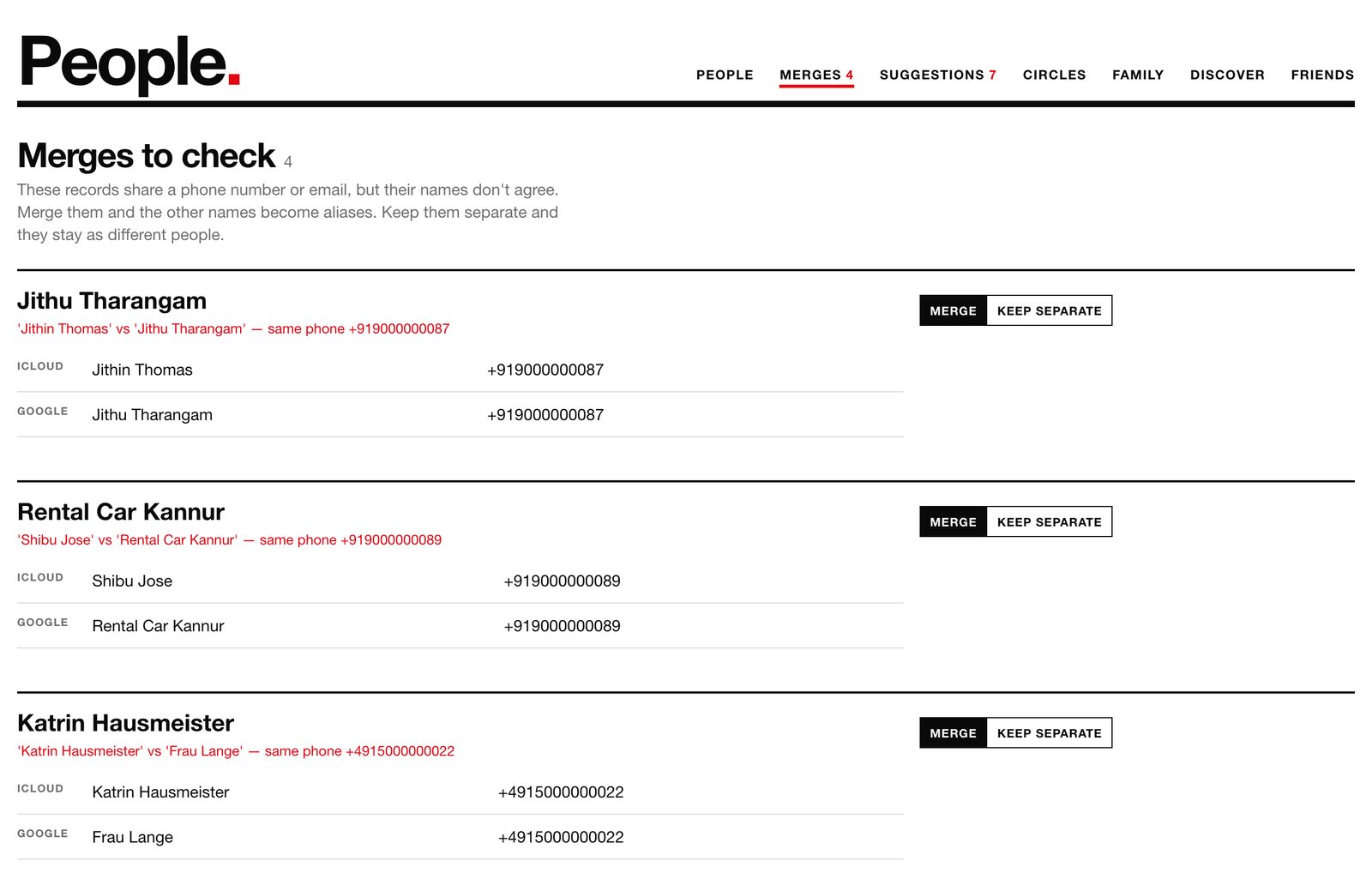 Merges to check: one number, two names that do not agree.
Call history and the iMessage database added a last-contact date for each person. About a thousand entries had no contact on any channel since 2020. No automatic rule drops them; I pick by hand, with the signals in front of me.
The review app
Claude built a small web app (FastAPI and htmx) to make those decisions: a list with every signal, Keep, Drop, and Unsure buttons, and a detail page that shows likely duplicates. Decisions live in their own database, so they survive a fresh extract.
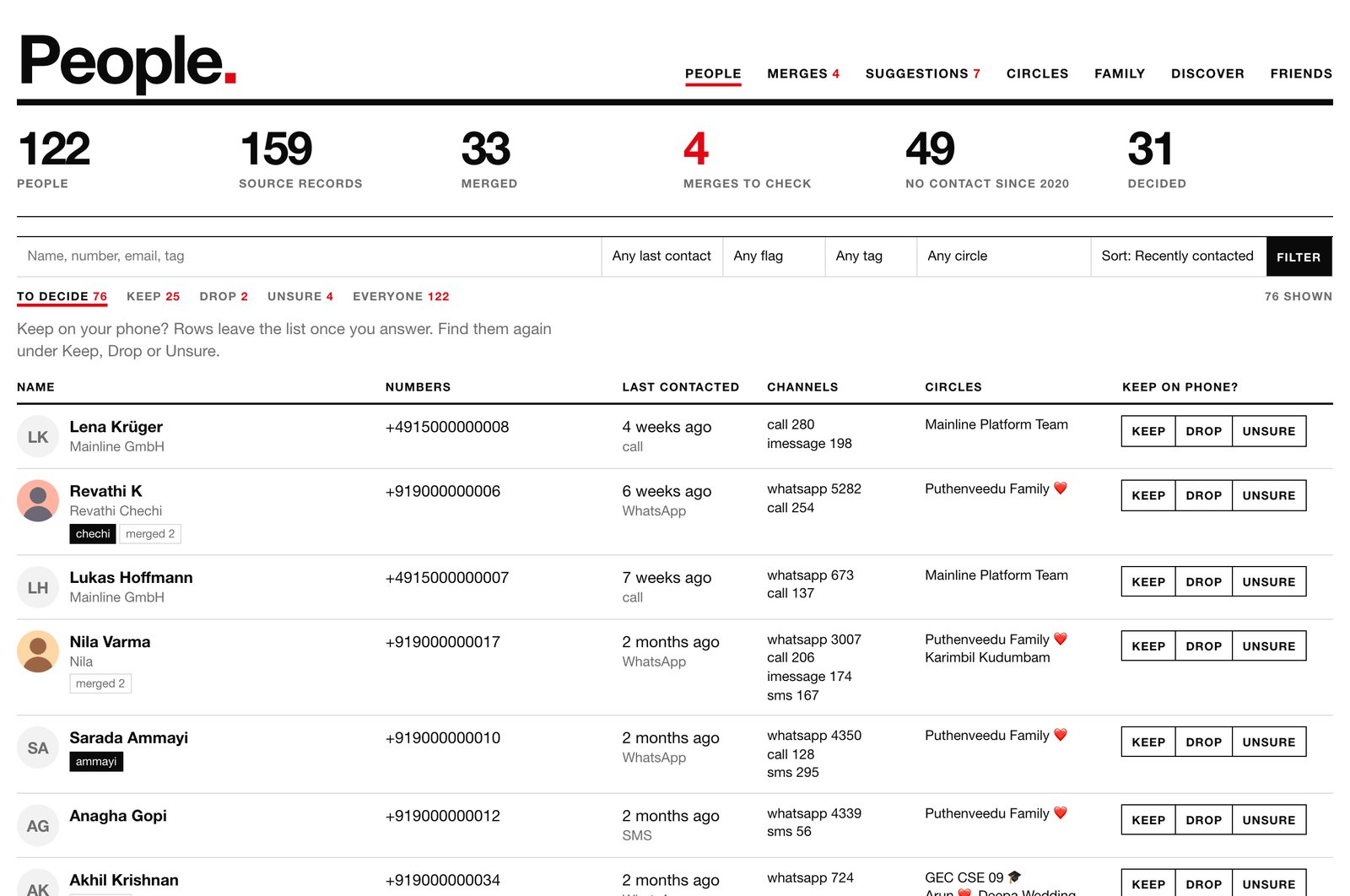 The list. Each row shows when we last talked, on which channels, and in which circles.
I asked Claude to restyle it in a named style, Swiss International, instead of the default look. I accepted 10 merges, linked 90 records as the same person, and marked 2 as different people. That left 1,124 people.
Contact photos and the WhatsApp profile cache gave 342 of them a face.
Circles and family
The 52 WhatsApp groups I share with others became 29 circles: family groups, Frankfurt friends, and others. The clustering still makes mistakes. One circle chains a building’s residents group, a gym group, and a wedding group together.
For relationships, the app stores only first-level facts: parent, child, sibling, spouse, and how we met. Everything else is derived. An in-law is a spouse’s sibling. A cousin is a parent’s sibling’s child. Each derived relationship also gets its Malayalam kinship term, which is more precise than the English one.
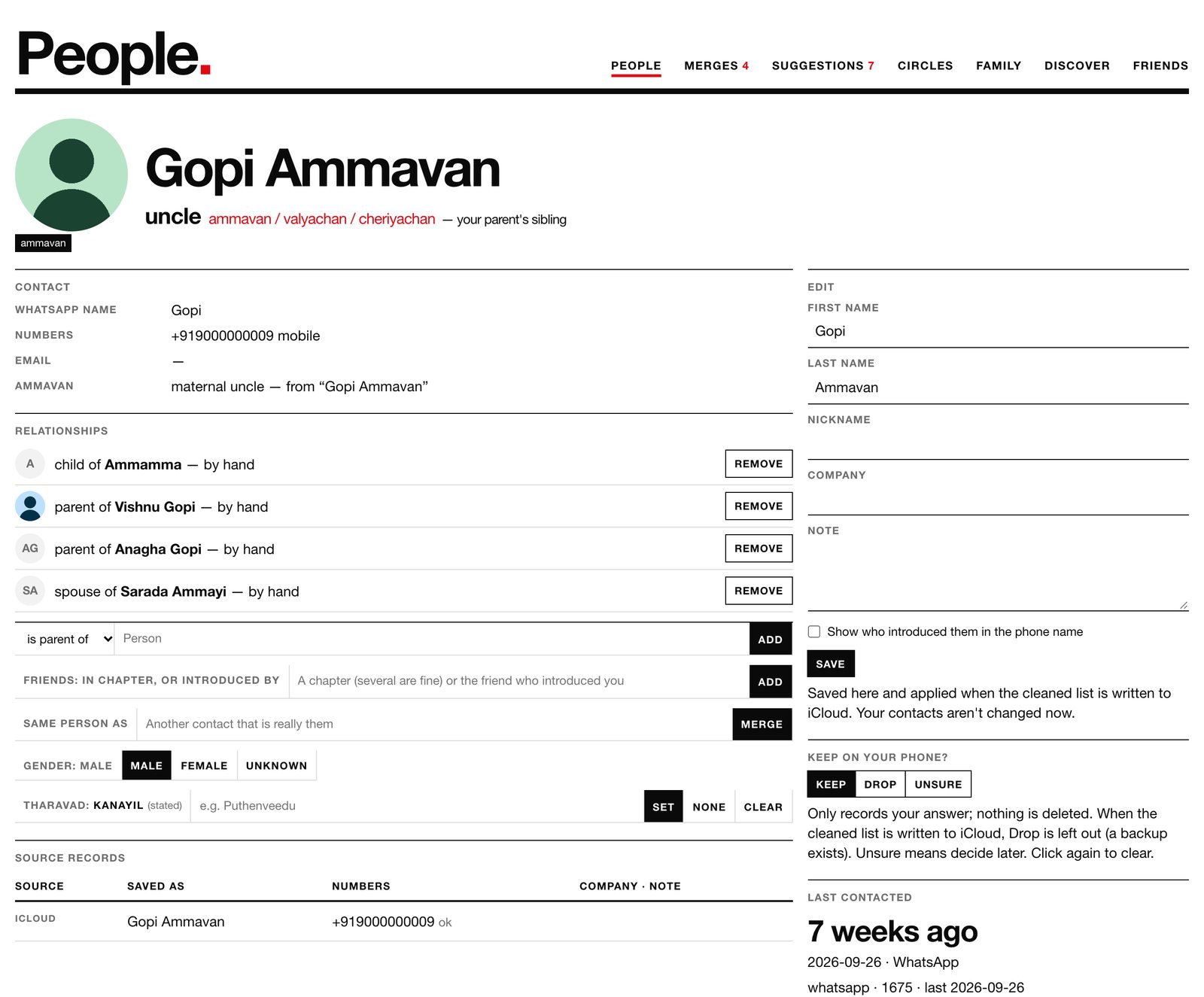 A person page. “Uncle” in English is three words in Malayalam.
Kinship words in saved names gave a head start. Malayalam honorifics like ettan (elder brother) and chechi (elder sister) appear in contact names, and they produced 92 kinship tags. The family tree then showed my own parents saved two or three times each, under slightly different names. The app now asks “same person?” for those.
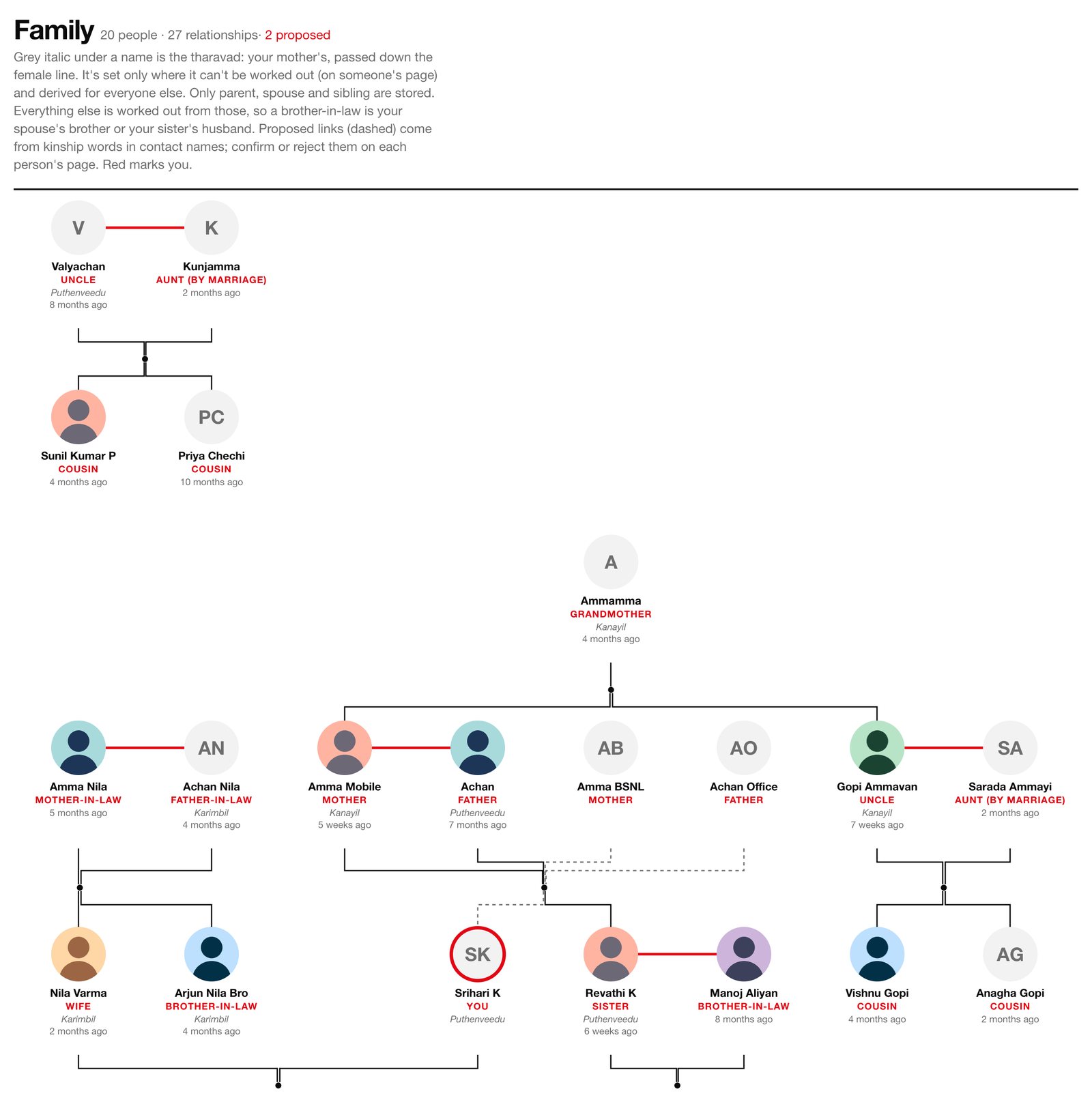 The family tree. Only parent, spouse and sibling are stored; the labels are derived. The dashed lines are proposals from contact names.
What is next
Name cleanup is next. A script handles the mechanical fixes, and Claude proposes given name, family name, nickname, and how I know each person, in batches, for me to approve in the app. The friends tree already places people in chapters (school, college, each job) on a timeline.
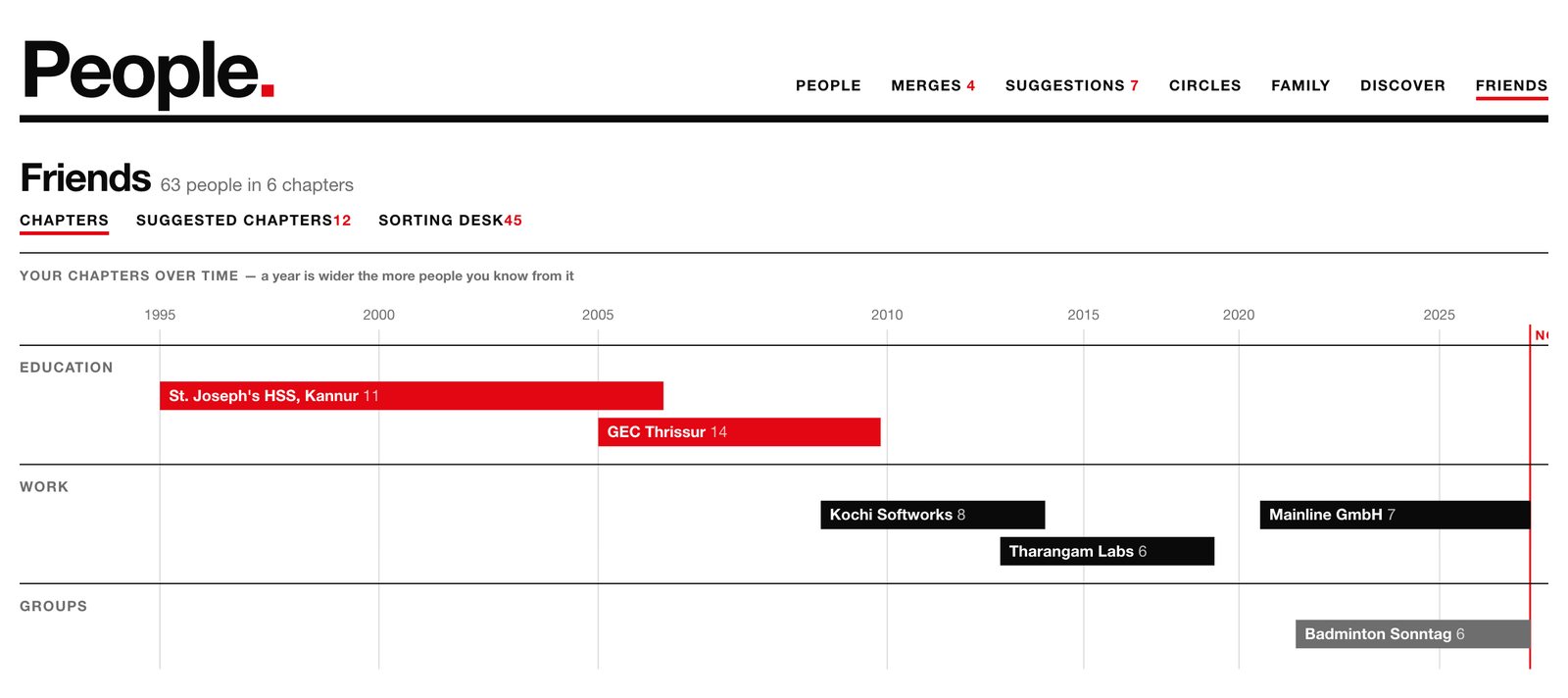 Chapters on a timeline. A bar is wider the more people I know from it.
The AI part
This is a low-priority hobby project. Claude wrote the extraction, the merge, the review app, and the family tree. I make the decisions only I can make: who is the same person, and how I know them.